Visual Note-Taking and Graphic Recording Glossary: 11 Terms, Defined
- Dusty Folwarczny
- Updated: September 24, 2026
Ask five people in this industry what they do, and you’ll get five different answers. One calls it graphic recording. Another says scribing. Someone else insists it’s visual note-taking, or graphic facilitation, or sketchnoting. They might all be describing something nearly identical (or something meaningfully different) and there’s no single rulebook that settles it.
Visual note-taking (or however you prefer to call it) is a relatively new industry that has grown through a lot of independent studios and practitioners at once, each landing on their own vocabulary. Below is a plain-language breakdown of the terms you’ll run into, grouped by what they actually describe, so you can walk into any conversation about visual communication and know exactly what’s being offered.

Terms for the Live, Real-Time Skill of Listening, Synthesizing, and Drawing Visual Summaries
These four terms overlap the most, and in casual use, people often treat them as interchangeable. Here’s where they actually differ.
Visual Notes / Visual Note-Taker
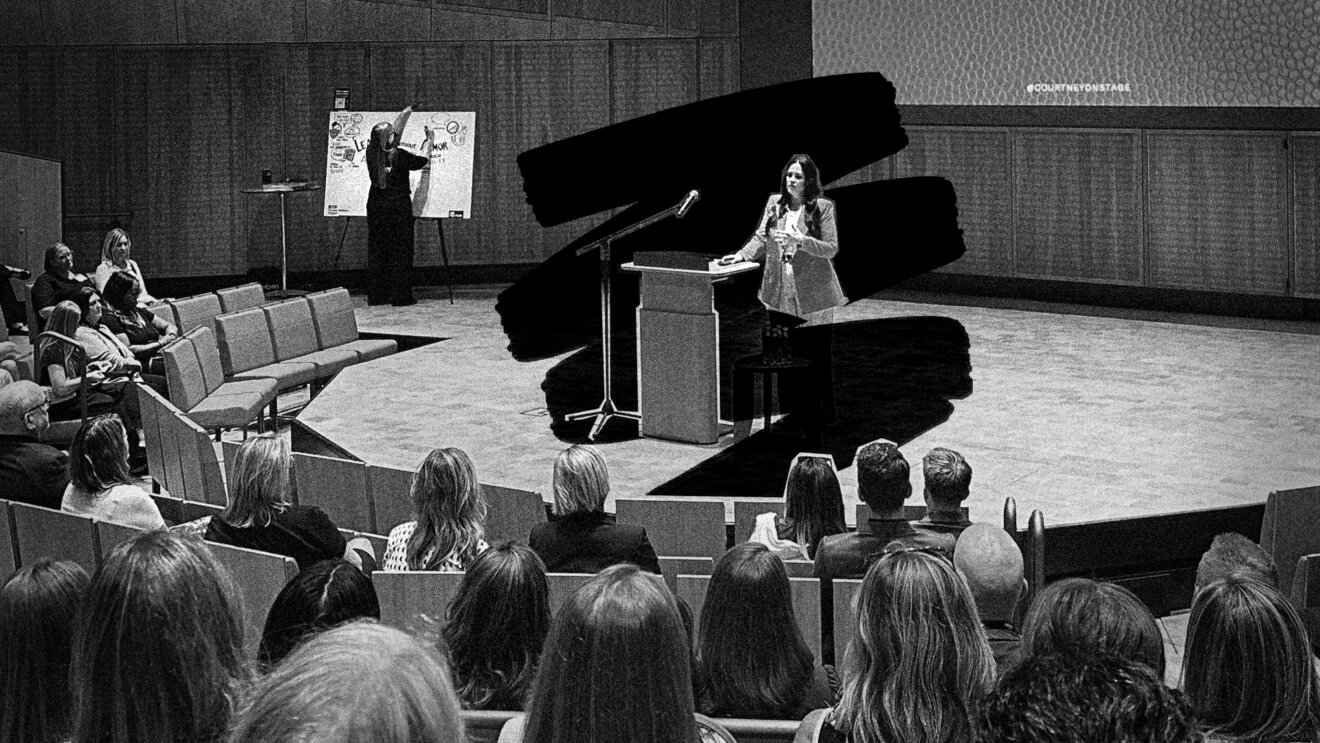
The short answer: real-time visual capture of a conversation, presentation, or discussion, using simple words and pictures, created live as the content happens.
The result is typically a single visual — on paper or a digital tablet — that summarizes the key ideas, structure, and takeaways of a session. It can happen at a conference, a strategy meeting, a webinar, or a boardroom. One who takes visual notes is called a visual note-taker.
Graphic Recording / Graphic Recorder
The short answer: the same live, real-time craft as visual notes, with a name that leans on the idea of “recording” the session as it unfolds.
We use “graphic recording” and “visual notes” completely interchangeably. There’s no formal industry standard separating them. Graphic recording is the more commonly used term among long-term practitioners. One who creates graphic recordings is called a graphic recorder.
Scribing / Scribe
The short answer: another name for the same live drawing skill
“Scribing” leans on the historical idea of a scribe: someone whose job is to faithfully capture what’s happening as it happens. Functionally, it describes the same real-time, event-based drawing work as the two terms above. If a studio calls their people “scribes,” they’re doing the same core job as a “graphic recorder.” One who visually scribes is called a visual scribe (or just a scribe).
Sketchnotes / Sketchnoting
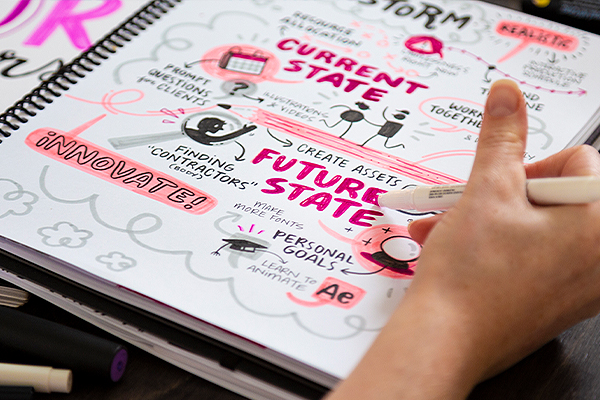
The short answer: a personal note-taking method, not a client-facing service — this is the term’s key distinction from the three above.
Sketchnoting describes individuals taking their own visual notes at a conference, lecture, or meeting for personal comprehension and memory, not a professional artist creating a deliverable for a client’s audience. Someone can “sketchnote” a keynote for themselves in a notebook using the exact same visual language a professional graphic recorder uses on stage. The craft overlaps heavily; the context (personal vs. professional service) is what separates them. One who sketchnotes is called a sketchnoter.
Terms for the people and the process

Artist
The short answer: the general term for the person doing the drawing, usually a trained illustrator working live.
“Artist” is the most accessible, least jargon-heavy way to describe who’s doing the work, which is part of why it shows up so often in client-facing language across the industry. Per the above definitions, the artist who creates live visual summaries can be called a visual note-taker, a graphic recorder, scribe, live sketch artist, or sketchnoter.
Visual Practitioner
The short answer: a broader umbrella term covering anyone whose professional work involves visual thinking including graphic recorders, graphic facilitators, sketchnoters, and visual consultants alike.
You’ll encounter this term most inside the industry itself. Professional associations like the International Forum of Visual Practitioners (IFVP) use it as the unifying category more than in everyday conversations with clients booking an event.
Graphic Facilitation / Graphic Facilitator

A related but distinct discipline that involves using visuals to actively guide a group’s process, not just document what’s said.
A graphic recorder typically captures a conversation as it happens. A graphic facilitator often does more: building visual frameworks or templates in advance to structure a group’s thinking, then filling them in collaboratively during a workshop to help the group reach a decision or shared understanding. It’s closer to a hybrid of facilitator and artist than a documentarian role. Think of a graphic recorder as a fly on the wall in a meeting; while a graphic facilitator is actually leading and guiding the meeting.
The types of visuals drawn by a graphic facilitator are typically much simpler and utilitarian and more reliant on text than those drawn by a visual note-taker, because they have to do two jobs at once, while a visual note-taker can solely focus on listening and drawing.
Related terms that get confused for visual notes
These may get confused with live visual note-taking because they share visual, hand-drawn DNA, but they describe different tools with different purposes.
Visual Storytelling / Visual Storyteller

A broader strategic concept, not a specific live-event service.
Visual storytelling describes using imagery (illustrations, hand-drawn video, branding, infographics) to communicate a narrative or message, live or otherwise. Live visual note-taking is one form of visual storytelling, but so are custom illustrations, explainer videos, and a well-designed slide deck. Think of it as the umbrella category rather than a synonym for graphic recording.
Rich Pictures

A systems-thinking and consulting technique for mapping a complex situation (the people, issues, and relationships involved) usually before trying to solve it.
Rich pictures originate from Soft Systems Methodology, developed by Peter Checkland, and are often built collaboratively in a workshop setting to help a group understand a messy problem before jumping to solutions.
Nowadays illustrators may use the term rich picture to refer to a polished illustration depicting a deep and layered ecosystem.
Rich pictures are hand-drawn and visual, and can be done in the style of visual notes, but they’re detailed illustrations, not a live capture of a meeting or event.
Mind Maps

A specific diagram format consisting of a central idea with branching sub-ideas radiating outward.
Popularized by Tony Buzan, mind maps are used for brainstorming, personal note-taking, or planning. A graphic recorder might use a mind-map-style layout as one visual technique within a larger board, but “mind mapping” describes a drawing structure, not a profession or service like graphic recording or visual notes.
Doodling
Informal, unplanned drawing, usually absent-minded marks made during a meeting, not a structured method for capturing or communicating ideas.
Doodling is something nearly everyone does: sketching in the margins of a notebook while a call runs long. It’s spontaneous and personal, with no intent to document content, organize information, or communicate anything to an audience. Professional visual note-taking borrows some of the same instincts. Simple icons, quick figures—but adds real intention behind them. The goal is to capture and communicate the actual substance of a conversation to other people, live, under pressure, in real time. Doodling is absent-minded mark-making, whereas the drawings in visual notes directly relate to the content.
Explainer Videos

Some visual note-takers can make explainer videos, and some explainer video creators can make visual notes, but they are not the same! Creating a video takes a different skillset–storyboarding, character design, timing/pacing, videography, lighting, and video editing.
Live visual notes have typically have a scale-based composition, where the key points are larger with smaller details radiating off of them. Explainer videos have to be organized more thoughtfully so they align with the script and message.
While a visual note can be created in 1 hour, an explainer video can take weeks of filming and production time.
Why we like "Visual Notes"
At Ink Factory, we use visual notes as our primary term — it’s direct, it applies cleanly across meetings and full conference stages alike, and it doesn’t require a definition before someone books it. Whatever term you’ve heard, if you’re picturing a real person turning a live conversation into a drawing people actually remember, you’re in the right place.
Curious what it looks like in action? Explore our visual note-taking services or get in touch to talk through your next event.

Dusty Folwarczny
Don't tell, show.
LET'S GET STARTED.


Visuals make it easier to communicate problem solve, and motivate people to take action.
Let us help you figure out how.
You won’t regret it
